




Why operational excellence, not capital intensity, drives sustainable warehouse productivity
India's retail supply chain landscape is experiencing a wave of high-investment automation, three-dimensional autonomous robots, automated storage and retrieval systems (ASRS), and sophisticated picking mechanisms deployed in micro-fulfilment centres. The narrative is compelling: replace labour-intensive processes with tireless machines that operate at unprecedented speeds. Industry reports estimate the global warehouse automation market will exceed $40 billion by 2027.
The implicit assumption is clear: those who don't automate aggressively will fall behind.
At more, we've taken a different view. Not because we oppose automation, but because we believe the question isn't "how much should we automate?" but rather "where does automation generate returns that justify its costs within a reasonable timeframe?"
This note explains our approach: surgical investment based on measurable returns, process optimisation before capital deployment, and a disciplined ROI framework that prioritises sustainable productivity over technological spectacle.
The Hidden Economics of Warehouse Robotics
Promotional materials for ASRS and robotic fulfilment systems showcase impressive capabilities. What they rarely show is the complete financial picture.
Capital intensity: A fully automated micro-fulfilment centre with ASRS and picking robots typically requires ₹15–25 crore in upfront investment for a facility handling 10,000–15,000 orders per day. This includes robotic hardware (₹8–12 Cr), racking systems redesigned for robot navigation (₹3–5 Cr), control software and integration (₹2–4 Cr), and facility modifications (₹2–4 Cr).
Payback period: At prevailing Indian labour costs (warehouse pickers earn ₹15,000–20,000 per month fully loaded), annual labour savings from full automation might reach ₹2–3 crore for a high-volume facility. This translates to 7–10 year payback periods. For context, typical warehouse lease commitments run 3–5 years.
Inflexibility: ASRS systems are designed for specific SKU profiles. A system optimised for small FMCG cartons doesn't efficiently handle 10-kg rice bags or fresh produce crates. When assortment mix evolves - which it inevitably does in retail - retrofitting is expensive and time-consuming.
Maintenance and downtime: Sophisticated automated systems require ongoing maintenance. Maintenance contracts typically run 8–12% of capital cost annually - an additional ₹1.5–2 crore per year that must be factored into the total cost of ownership.

This doesn't mean automation is wrong. It means automation is a tool that must be evaluated rigorously. The question isn't "should we automate?" but "where does automation generate returns that exceed its costs within a defensible timeframe?"
At more, that timeframe is 12–18 months. Investments that cannot demonstrate payback within this window, regardless of technological sophistication, do not proceed!
The Multi-Format Challenge
Single-format operations can optimise for one use case: delivery-only fulfilment from compact dark stores with 3,000–6,000 SKUs within a 2 km radius. For that specific model, aggressive automation can deliver geometric returns.
More Retail operates across multiple formats, each with distinct operational characteristics:
| Format | Avg. Size | SKUs | Order Type | Velocity Pattern |
|---|---|---|---|---|
| Supermarkets | 2,000–4,000 sq ft | 4,000-6000 | Walk-in + delivery | Peaks: weekends, evenings |
| Dark Stores | 2,000–4,000 sq ft | 4,000–6,000 | Delivery only | Peaks: lunch, dinner windows |
| Dry DCs | 40,000–80,000 sq ft | 12,000–18,000 | B2B replenishment | Continuous, batch-driven |
| Fresh (F&V) DCs | 15,000–30,000 sq ft | 800–1,500 | B2B, high-turn | 4 am–10 am window |
| Reprocessing Centres (RPCs) | 10,000–20,000 sq ft | 500–2,000 | Bulk-to-pack conversion | Demand-triggered |
Each format has different SKU profiles, velocity patterns, handling requirements, and labour economics. A robot designed for small-carton FMCG picking is unsuitable for RPCs processing 25 kg staple bags. Systems optimised for ambient goods cannot handle the 4–8°C cold chain requirements of fresh produce.
For multi-format retailers, the path forward isn't a single technological bet - it's surgical investment where returns are clearest and most defensible.
What We're Actually Building
Rather than pursuing headline-generating automation, we've focused our investment on four areas where returns are measurable and payback is demonstrable:
1. Software as Infrastructure: Rogue One (R1)
The most underleveraged asset in Indian retail warehousing isn't robotics - it's software. Many retailers operate on legacy WMS platforms designed for different eras and cost structures.
Three years ago, we built our own warehouse management system in-house: Rogue One (R1).
R1 now controls receiving, putaway, inventory tracking, picking, packing, and dispatch across all dry DCs, with rollout underway to fresh distribution centres. The results:
| Metric | Before R1 | After R1 | Change |
|---|---|---|---|
| Pick time per store pick | 31 sec | 17 sec | –45% |
| Inventory dwell time at DC | 21 hrs | 12 hrs | –43% |
| Picker productivity (units/day) | 5500 | 7500 | +36% |
| Receiving discrepancy rate | 3.2% | 0.5% | –84% |
| Direct IT cost savings | - | ₹40 lakh/month | - |
The pick time reduction achieved through optimised pick paths, system-directed sequencing, and elimination of paper-based processes matches what many ASRS implementations promise, at a fraction of the capital cost.
More importantly, R1 generates granular operational data. We can now identify exactly where time is lost, which SKUs cause exceptions, which suppliers create receiving bottlenecks, and which demand patterns generate inefficient order profiles. This visibility enables continuous optimisation without continuous capital expenditure.
2. Multi-Echelon Inventory Optimisation (MEIO)
Most inventory challenges aren't warehouse problems - they're network problems.
Traditional inventory planning treats each location independently. The store calculates its reorder point. The DC calculates its reorder point. The RPC calculates its reorder point. Each node optimises locally, while the network overall ends up with excess inventory in some locations and shortages in others.
MEIO takes a network-wide view, considering demand variability at each node, lead times between nodes, cost of holding inventory at different echelons, and service level implications of stock placement. The mathematics is complex (stochastic optimisation across multiple nodes with correlated demand), but the output is practical: optimal inventory placement and quantity.
For more, MEIO is particularly powerful given our multi-echelon network:
Vendor/RPC → DC → Hub/Child DC → Store/Darkstore
A naive approach holds safety stock at every node. MEIO identifies that holding strategically higher inventory at the DC - where storage costs are lower, and pooling effects reduce variability - can reduce total network inventory while improving downstream fill rates.
Early results from MEIO pilots demonstrate:
-
18–22% reduction in network inventory for participating categories
-
Improved store availability (fewer stockouts despite lower total inventory)
-
Reduced DC-to-store transfer frequency (fewer, fuller shipments)
This work directly impacts P&L without requiring robotic infrastructure.
3. Process Redesign Before Automation
Before asking "what should we automate?", we systematically ask "what should we eliminate?"
Example 1: Multi-invoice receiving. Vendors frequently deliver against multiple purchase orders with multiple invoices. Previous process: receive each invoice separately, handling identical SKUs multiple times across documents. Revised process: consolidate receiving across invoices, handle common items once. Result: 20–30% improvement in receiving productivity, zero capital investment.
Example 2: Return-to-vendor (RTV) flow. Previously, RTV items remained in DC inventory until manually processed across two systems, creating phantom inventory that confused replenishment algorithms. We redesigned the entire flow within Rogue One - single system, automated status updates, no inventory ambiguity. Result: cleaner inventory data, fewer replenishment errors, better vendor compliance.
Example 3: LPN reallocation. When stores return slow-moving inventory, the traditional approach is: receive at DC → putaway → re-pick for another store. We implemented optimisation logic (using Google OR-Tools) that reallocates LPNs in transit, enabling returns to bypass pick flow entirely and proceed directly to destination stores. Result: ~20% reduction in receiving labour for return operations.
These aren't technological breakthroughs. They represent process discipline, identifying waste and eliminating it systematically.
4. Selective Automation Where ROI is Proven
We're not opposed to automation. We're opposed to automation without demonstrable returns.
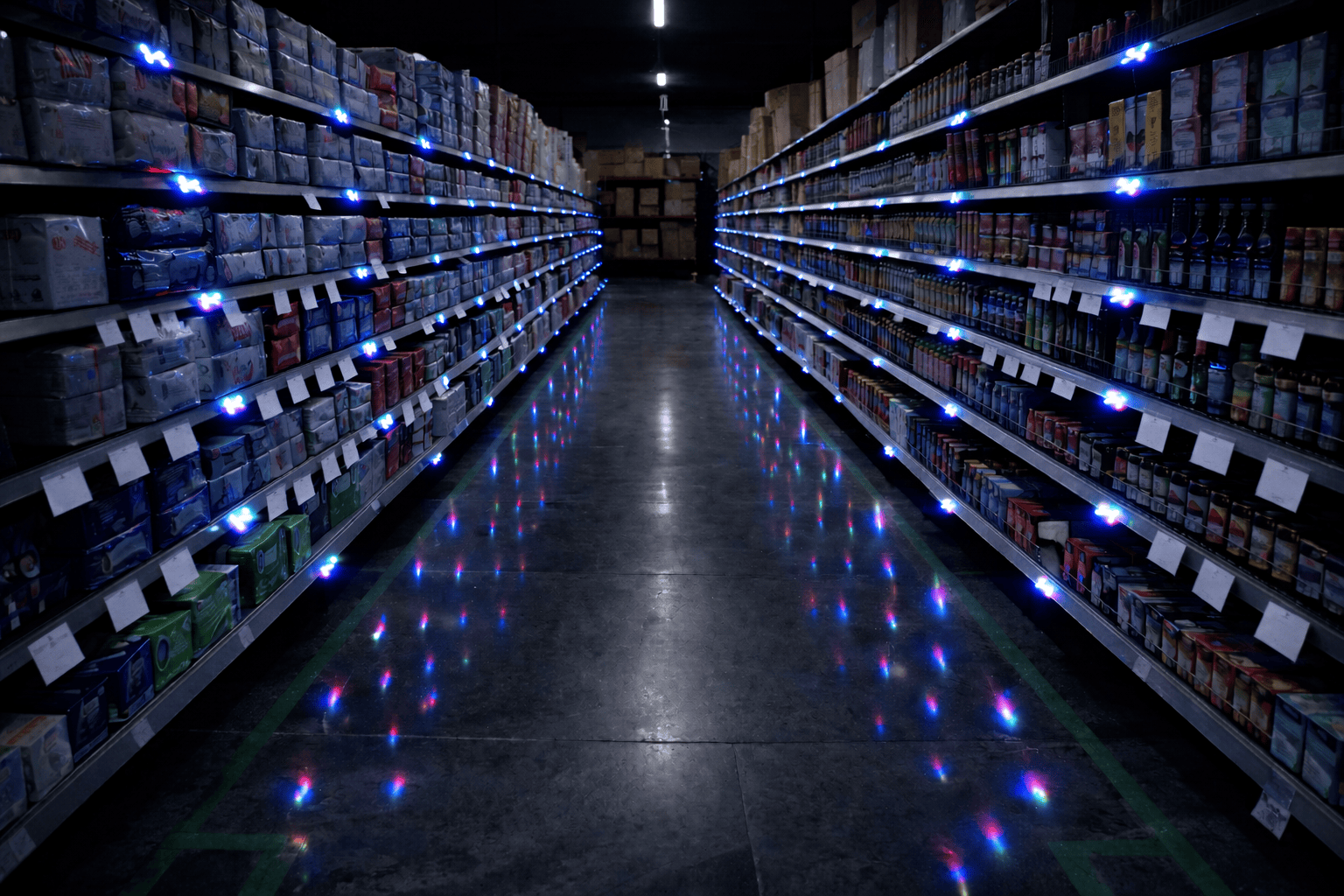
Pick-to-light in dark stores: We completed proof-of-concept deployments of pick-to-light devices (LED indicators at bin locations) in selected dark stores. Pickers no longer need to memorise sequences or interpret pick lists as the system illuminates next pick locations. Check-in time reduced by 70%. Payback period: 12 months. Rollout is proceeding.
Conveyor systems in high-volume DCs: For our new Bangalore DC, we're implementing conveyor automation for bulk picking and tub movement - the highest-volume, most labour-intensive material flows. The economics:
| Parameter | Value |
|---|---|
| Capital investment | ₹1.0–1.5 crore |
| Mover reduction | 30 → 15 (50%) |
| Annual savings | ₹32 lakh |
| Payback period | 3–5 years |
This exceeds our standard 12-month ROI threshold, but falls within an acceptable range for infrastructure that will outlast multiple lease cycles. Critically, conveyors are modular, format-agnostic, and don't require the SKU-specific configuration that ASRS demands.
What we're deferring: Full ASRS implementation. Autonomous mobile robots (AMRs) for picking. Robotic arms for palletising. Each currently demonstrates payback periods exceeding 7 years at our volumes and labour costs. Should economics change - if labour costs rise substantially, robot costs decline significantly, or our volumes increase materially - we will re-evaluate.
The Operational Excellence Thesis
The prevailing industry narrative suggests that speed requires automation, automation requires robotics, and robotics requires substantial capital. The logical endpoint is an arms race of capital deployment.
We're pursuing a different thesis: operational excellence beats capital intensity.
The most effective warehouse isn't the one with the most robots. It's the one where: - Software eliminates unnecessary steps before they occur - Inventory sits at the optimal network echelon - Processes are designed for single-touch efficiency - Automation is deployed surgically, where returns justify costs - Continuous improvement compounds over years, not quarters.
This approach requires less capital, generates faster returns, and builds institutional capability that cannot be replicated through financial investment alone.
It's also less photogenic. There are no autonomous fleets for media coverage. No "AI-powered warehouse of the future" announcements. Simply the disciplined work of making existing operations incrementally better, daily, across hundreds of locations.
We believe that constitutes a sustainable competitive advantage.
Investment Priorities for 2025–26
Our supply chain investments focus on three priorities:
-
R1 rollout to F&V DCs: Extending the same visibility, process control, and productivity gains achieved in dry distribution to our fresh produce network, where speed and accuracy matter even more given short shelf life.
-
RPC ARS implementation: Fully automated replenishment planning for repack centres, connecting multi-echelon inventory optimisation to production scheduling and raw material procurement.
-
Hyperdrive integration: Connecting our transport management system to R1, enabling system-driven trip creation, route optimisation, and dispatch discipline.
Each of these builds on existing infrastructure. Each generates returns that justify costs within our investment framework. Each strengthens operational capability without requiring transformational capital deployment.
This approach may be less dramatic than deploying warehouse robotics. But we believe it's more sustainable - operationally and financially.
For inquiries about More Retail's supply chain operations, contact hello@more.in