



Why your grandmother aged rice for a year before cooking it - and the science that explains she was right all along.
There's a peculiar test that grain merchants in the Indo-Gangetic plains have conducted for generations. They take a single rice grain, press it gently between their teeth, and listen. A crisp, clean snap means the grain is properly dried. A soft, yielding crunch suggests excess moisture and inevitable spoilage within months.
No laboratory instrument can replicate what that bite tells an experienced buyer: the story of where the grain grew, how it was harvested, whether it was dried too quickly in industrial kilns or left to mature slowly under the winter sun.
This is where the conversation about "premium" staples should begin, not with marketing claims, but with understanding what actually happens at the molecular level when rice ages. Because once you understand the chemistry, you'll never look at a packet of rice the same way again.
Where Your Rice Actually Comes From
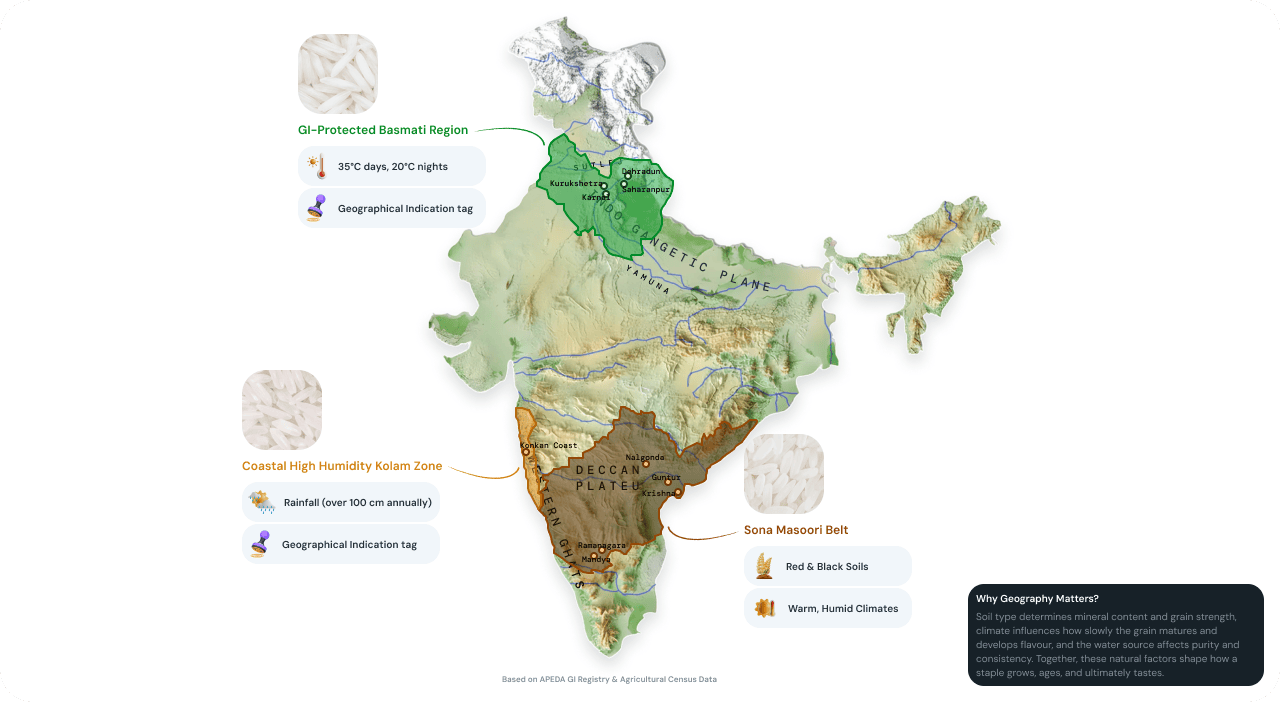
India produces over 130 million tonnes of rice annually across wildly different terrains. And here's something most people don't realize: the variety determines the dish, and the geography determines the variety.
The Basmati Belt: Think of the region between Punjab and Uttarakhand as India's wine country for rice. Basmati needs hot days (35°C+), cool nights (20°C), and the mineral-rich water flowing down from the Himalayas. Try growing it anywhere else, and you'll get rice that looks like basmati but smells like... well, nothing. The fragrance only develops in these specific conditions. That's why authentic basmati carries a GI (Geographical Indication) tag just like Champagne from France or Darjeeling tea.
Sona Masoori's Southern Soul: Ever wonder why Sona Masoori works so perfectly with sambar and rasam? It's slightly stickier than basmati - not mushy, just clingy enough to soak up those flavors. It grows in the red and black soils of Karnataka, Telangana, and Andhra Pradesh. The name tells you its story: "Sona" (golden) meets "Masoori" (an heirloom variety).
Kolam from Maharashtra: Grown in Palghar district's coastal belt (yes, it has a GI tag too), Kolam rice evolved to survive humid, fungus-prone conditions. Shorter, harder grains that don't break easily - the everyday workhorse of Maharashtrian kitchens.
We source from farming partners across these regions:
-
Punjab & Haryana: Premium Basmati
-
Karnataka: Sona Masoori, BPT & RNR
-
Telangana, AP: Ponni
-
Maharashtra: Kolam (From Wada, Palghar)
-
Kerala: Matta rice (the reddish, nutty one), Jaya & Surekha
-
West Bengal: Minikit & Baskati
Here's the point: there's no single "best" rice. Only the right rice for what you're cooking.
Through our 850+ stores across India and growing online presence, we bring these regional specialties to customers nationwide - whether you're in Mumbai buying Kerala's Matta rice or in Delhi sourcing West Bengal's Minikit.
The Ageing Paradox: Why Fresh Isn't Always Best
Ask any home cook in Lucknow or Hyderabad about rice, and they'll tell you the same thing: naya chawal (new rice) is for kheer; aged rice is for biryani. This isn't superstition. It's applied chemistry, passed down through kitchens long before laboratories could explain it.
When rice is freshly harvested, it's packed with moisture (as high as 14–15%). Cook it immediately, and you get soft, sticky grains - lovely for a creamy rice pudding, disastrous for a biryani where you want each grain separate.
But leave that same rice in controlled storage for 6 to 18 months, and something remarkable happens.
What happens during ageing:
As rice sits, natural oils on the grain surface slowly form a protective layer. Think of it like waterproofing a jacket - water can't rush in all at once. Result? When you cook aged rice, each grain absorbs water evenly, swells uniformly, and stays separate instead of clumping into a sticky mass.
The moisture inside gradually evaporates too. Over months, grains lose their water weight and firm up. This is why aged basmati stretches almost twice its length when cooked (imagine an 8mm grain becoming nearly 16mm), while fresh rice barely stretches at all.
And that signature basmati fragrance? It concentrates as moisture leaves, which is why properly aged rice smells like popcorn and toasted nuts when cooking.
🍚 IN YOUR KITCHEN:
Fresh rice = sticky, clumpy (perfect for kheer, fried rice)
Aged rice = fluffy, separate grains that stay tender longer after cooking (your biryani's secret weapon)
That's why Selecta sources rice already aged 12–18 months before it reaches you.
This is why, at More Selecta's sourcing operations, we specifically work with processors who properly age rice for 12–18 months. It costs more. It takes patience. But it's what makes restaurant-quality biryani possible at home.
What "45 Quality Checks" Actually Means
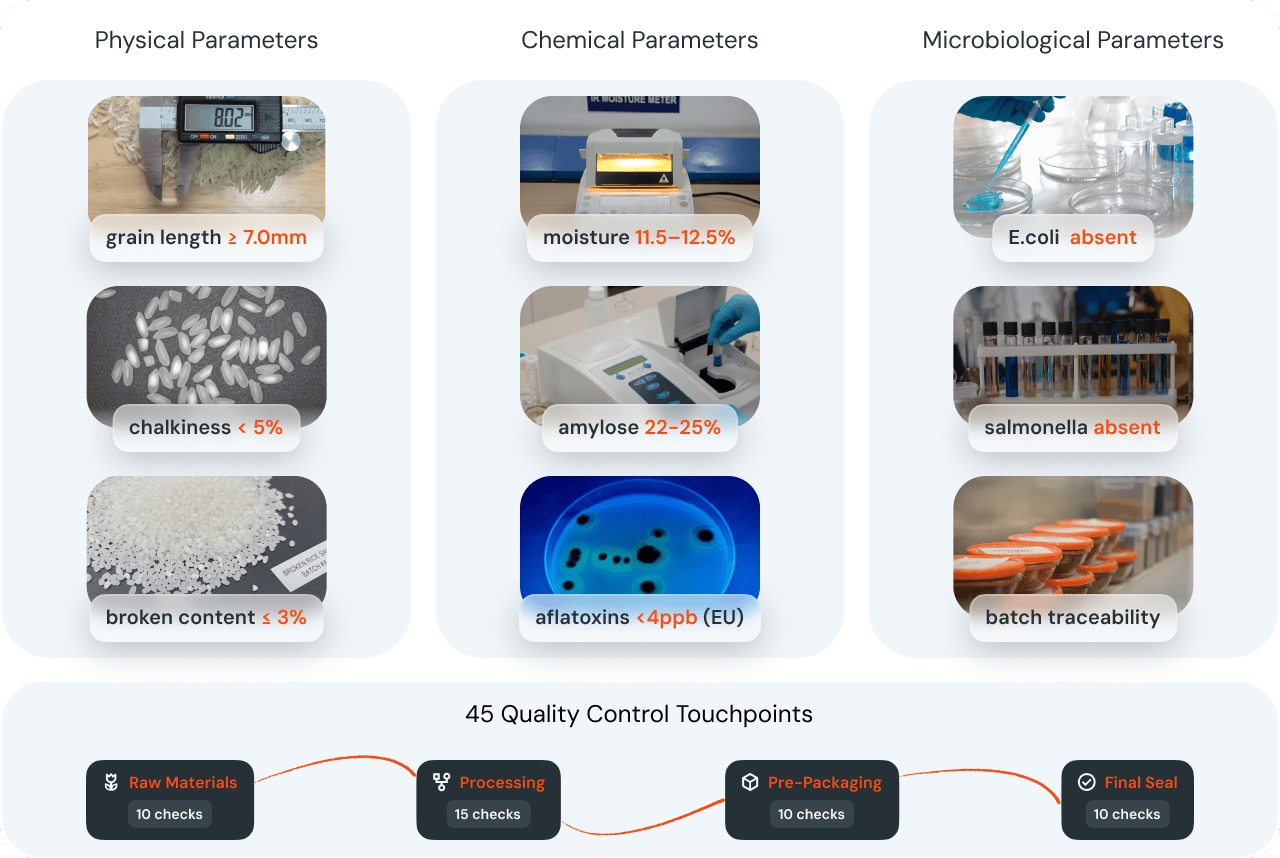
Every food brand claims rigorous quality control. The number is almost meaningless without context. Here's what those checks actually look for:
Where It Starts
We source raw material directly from millers based at sourcing origin locations - ensuring quality control begins at the source, not at our warehouse.
The Checks
What You Can See (Physical Quality):
-
Grain length and uniformity: For basmati, regulations say grains should be at least 7mm long. But here's the trick: a batch with 70% long grains and 30% broken pieces technically passes that standard yet cooks terribly. We reject batches where grains are too inconsistent, because mixed sizes mean uneven cooking.
-
Chalkiness: See those white, chalky spots on some rice grains? That's where the grain didn't develop properly (usually heat stress during farming). Chalky grains cook faster and break easily. Open a budget rice pack and you'll find them everywhere. Premium rice limits these to less than 5% of the batch.
-
Broken grains: Regulations allow up to 5% broken grains. Doesn't sound like much, right? But broken pieces cook faster than whole grains - by the time your whole grains are done, the broken ones are mush. Selecta rejects batches with more than 3% broken content. Yes, we're that particular.
🍚 KITCHEN REALITY CHECK:
Open any rice packet and spread it out. See broken pieces? Mixed sizes? Chalky white grains?
That's why your biryani sometimes comes out unevenly cooked - half fluffy, half mushy.
Premium rice = consistent size + minimal broken pieces = uniform cooking.
What You Can't See (Chemical Quality):
-
Moisture content: Too wet (above 12.5%) and you're literally paying for water plus risking fungal growth. Too dry (below 11.5%) and grains turn brittle, shattering during transport. The sweet spot is narrow: 11.5–12.5%. Every batch gets tested.
-
Why some rice cooks fluffy vs sticky: Rice contains two types of starch. High levels of one type make rice cook fluffy and separate (like basmati). Lower levels make it soft and sticky (like Sona Masoori). Lab testing ensures you get what the packet promises, not a random mix.
-
Pesticide residue: We test pesticide residue as per FSSAI-defined frequency and comply with FSSAI safety standards.
The Hidden Dangers (Crop Contaminants):
- Aflatoxins: These are toxic compounds from fungus that grows on improperly stored grains. You can't see them. You can't smell them. But they're one of the most dangerous food contaminants. We test for these and comply with FSSAI limits (max 15 µg/kg) through proper storage and handling.
Each check catches something that could ruin your meal or worse, make you sick.
Why We Pack Everything In-House
Most branded staples follow a simple model: buy processed goods from a third-party, slap on a label, ship it out. Economically efficient. Also quality-blind.
Here's what can go wrong: Rice perfectly processed in January can arrive at your kitchen in April with weevil damage, moisture problems, and off-odors. Not because the processor messed up, but because what happened in between wasn't controlled.
A warehouse that hit 42°C for three weeks in May? Months of careful ageing undone. Poor pest control at a distribution center? Insect contamination in perfectly clean product. Cheap packaging? Light and moisture seep in, degrading quality.
More Selecta's packing facility controls that last 20% of the quality chain:
-
Temperature-controlled storage: For dry fruits and temperature-sensitive products. Rice is packed at ambient temperature (which actually preserves grain quality better).
-
Final inspection before packing: Every batch gets checked again. Quality only improves through our final cleaning and grading - we catch what others miss.
-
Better packaging: Thicker materials that protect longer. (We use nitrogen flushing selectively like for Zahidi and Fard dates - where it genuinely helps.)
-
Daily sanitation: Contact surfaces cleaned daily, air quality monitored, pest control documented.
-
Strong farming partnerships: Our network of 250+ trusted suppliers across India's rice-growing regions ensures consistency from farm to shelf.
Is this more expensive to operate? Absolutely. Is this why Selecta costs more? Partly. But it's also why a Selecta packet opened six months after purchase cooks exactly like one opened yesterday.
🏪 THE REAL DIFFERENCE:
Most brands can't guarantee what happens between the processor and your kitchen. We control the entire chain which is why quality doesn't degrade sitting on a shelf.
The Honest Difference Between Selecta and Choice
More Retail operates two staple brands - Selecta and Choice - and customers reasonably ask: what's actually different?
Selecta (Now 33% of Our Staples Business):
Think of Selecta as what we launch when we can prove a quality difference. Not just claim it but actually measure it.
-
Rice aged 12–18 months (vs 6–12 for regular brands)
-
Maximum 3% broken grains (most brands: 8% or higher)
-
GI-certified source regions (the actual basmati belt, not secondary areas)
-
Our own internal quality standards that exceed legal requirements
Here's what makes Selecta different from competitors' "premium" lines: We don't launch a Selecta product unless there's a measurable, significant quality jump. Other brands launch multiple tiers of essentially the same quality at different price points. That's not what Selecta is. If we can't justify the premium with actual specs, it doesn't get the Selecta name.
That's why spices and oils are only available as Choice because for those categories, we haven't yet found a way to deliver measurably superior quality that justifies premium pricing.
Choice (Trusted for 20+ Years):
Choice isn't "good enough" quality. It's "exceeds legal requirements and delivers consistent results" quality.
-
Surpasses all FSSAI standards (not just meets them)
-
Premium source regions and careful processing
-
Value-priced without compromising safety or consistency
-
Your reliable everyday brand
What's Available Where:
-
Rice, Pulses, Dry Fruits: Both Selecta and Choice
-
Flours (Atta, Maida, Suji, Besan): Both Selecta and Choice
-
Spices, Millets, Oils: Choice only
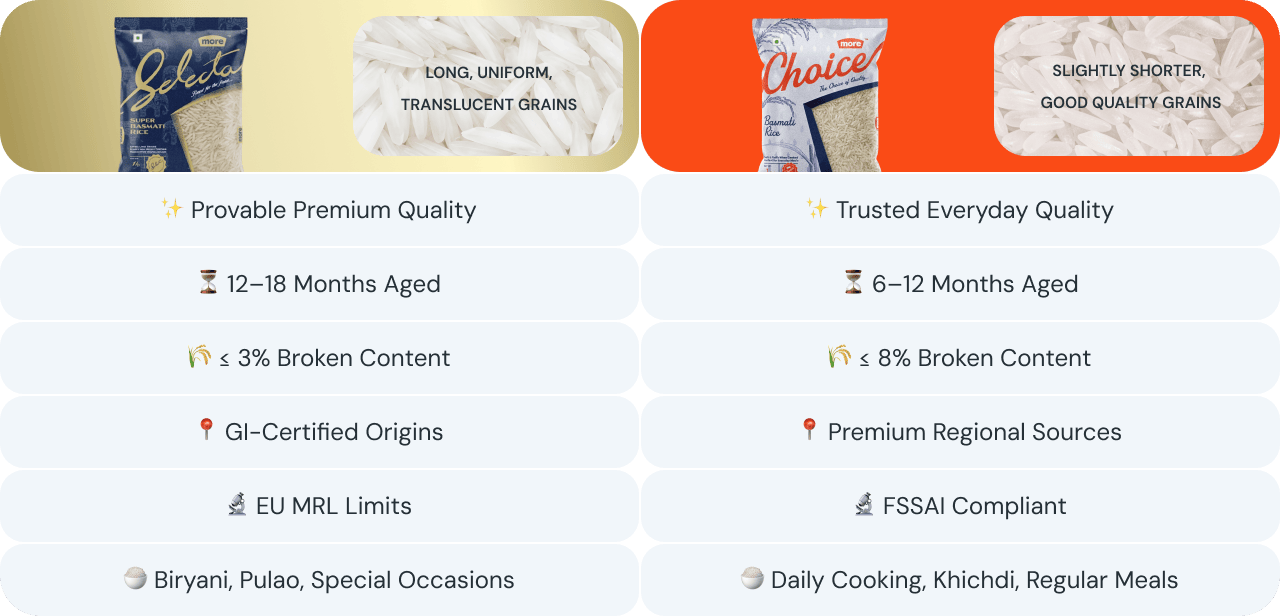
Neither is "bad." If you're making khichdi on Tuesday night, Choice delivers excellent results. If you're serving biryani to guests, Selecta's specifications will show in every grain.
The difference: Selecta = provable premium quality. Choice = consistent reliability. Both backed by More Retail's 20+ years of experience.
💡 THE HONEST TRUTH:
We could slap "Selecta" on everything and charge more. We don't. Selecta only exists when we can measure the quality difference and justify the price.
How to Check Quality Yourself (Works for Any Brand)
Want to evaluate rice or dal quality before buying? Here's what to look for:
For Rice:
-
Spread it out: Open the packet and pour some on a plate. Are grains roughly the same size and color? Mixed sizes = uneven cooking.
-
Hold it to light: Translucent (clear-ish) grains are better than chalky white ones. Too many chalky grains means they didn't develop properly and will cook unevenly.
-
Smell test: Raw rice should smell neutral or faintly sweet. Musty or cardboard smell? That's moisture damage or old stock. Don't buy it.
-
Cook a handful: Good rice finishes cooking with most grains intact. If half the batch breaks apart while cooking, the grain structure was already compromised before you opened the packet.
For Pulses (Dal):
Note: We pack unpolished dal for both Choice and Selecta. The quality difference is in grain count per kg, broken percentage, and moisture content, not in polishing.
-
Check the surface: Dal should look natural and even. Lots of nicks and scratches mean rough handling or over-processing.
-
Color check: Uneven color means mixed batches or improper drying which leads to uneven cooking.
-
Look for debris: Premium dal should have almost zero foreign matter. Finding stones or stems? That's poor quality control.
-
Cooking test: Good dal cooks uniformly. If half the pot turns to mush while the other half is still hard, the batch was inconsistent in age or quality.
👀 QUICK QUALITY CHECK:
Before you buy, look through the packet (if possible):
✓ Consistent grain sizes
✓ Minimal broken pieces
✓ No Foreign Matter - (Stones, Organic, Inorganic & Metallic Impurities)
✓ Clear/translucent grains (not chalky white)
These visual clues tell you more than any marketing claim on the label.
Truth With Humility
There's no secret ingredient in premium staples. No proprietary magic. No hidden technique competitors don't know about.
What separates premium from regular isn't clever marketing. It's boring, expensive discipline:
-
Rejecting batches that technically pass legal standards but aren't good enough
-
Investing in laboratory equipment and trained quality staff
-
Aging rice for 12–18 months instead of rushing it to market for quick cash
-
Using thicker packaging even though it costs more
-
Testing every batch even when the law doesn't require it
That's it. That's the whole secret.
Most consumers will never see these quality steps. But they'll taste them in rice that cooks evenly, in dal that's free of stones, in dry fruits that haven't turned rancid on the shelf.
The difference between good staples and great staples isn't on the label. It's in the choices made when nobody's watching.
And now you know what to watch for.
More Selecta and More Choice are available at 850+ More stores across India and online via the More app.
For the curious: If you have questions about sourcing, want to understand specific quality parameters, or simply want to go deeper into the science of staples, reach us at hello@more.in. We're always happy to talk food science.